
Coding
Excel’s math and trig functions unlock powerful data analysis capabilities—from financial modeling to engineering calculations. Master these essential formulas to transform raw numbers into actionable insights without writing a single line of code.
SUMIFS Function for Conditional Data Addition

Tired of summing values only to realize you forgot to filter by category, date, or status? The SUMIFS function lets you add numbers based on multiple conditions—perfect for budget tracking or sales reports where precision matters.
With syntax like =SUMIFS(sumrange, criteriarange1, criteria1, [criteria_range2, criteria2]...), you can sum only rows where revenue exceeds $1,000 AND the status is "completed"—all in one formula. Unlike SUMIF, which handles just one condition, SUMIFS stacks up to 127 criteria (Excel’s limit), making it ideal for complex datasets.
Small business owners and analysts will love how SUMIFS cuts manual filtering time by 80%. Try it on your next dataset—your reports will thank you. 💡
SIN and COS Functions for Engineering Calculations

Need to calculate forces, wave patterns, or structural angles without diving into code? The SIN and COS functions in Excel are your go-to tools for converting angles into precise trigonometric values—whether you're working in degrees or radians. These functions don’t just return numbers; they unlock physics simulations, architectural designs, and even game development calculations with minimal effort.
Use SIN(angle) to calculate the ratio of the opposite side to the hypotenuse (e.g., =SIN(90) returns 1), or COS(angle) for the adjacent side ratio (e.g., =COS(45) returns 0.7071). Both functions accept angles in degrees by default but seamlessly switch to radians if you multiply your input by PI()/180. For example, =SIN(RADIANS(30)) gives the exact same result as =SIN(30)—just in radians.
Architects will love using these to model truss systems or roof slopes, while physics students can simulate projectile motion or harmonic oscillations without a calculator. Pair them with DEGREES() or RADIANS() for unit consistency, and you’ve got a battle-tested setup. ✨
ROUNDDOWN and ROUNDUP for Financial Precision
When tax season rolls around or inventory costs demand strict precision, ROUNDDOWN and ROUNDUP become your financial safety net. Unlike standard rounding, these functions enforce GAAP compliance by controlling how numbers behave—critical for minimizing tax liabilities or ensuring inventory valuation accuracy.
Use ROUNDDOWN to floor values (e.g., =ROUNDDOWN(123.99, 0) returns 123) for conservative estimates like tax deductions, while ROUNDUP (e.g., =ROUNDUP(123.01, 0) returns 124) covers costs like shipping or safety stock. Both accept a decimal_places argument for granular control—perfect for currency or multi-decimal metrics.
Accountants and small business owners will appreciate how these functions eliminate rounding errors in financial reports. Just remember: ROUNDUP always rounds away from zero, while ROUNDDOWN rounds toward zero—your secret weapon for audit-proof spreadsheets. ✨
ATAN2 Function for Accurate Angle Calculations
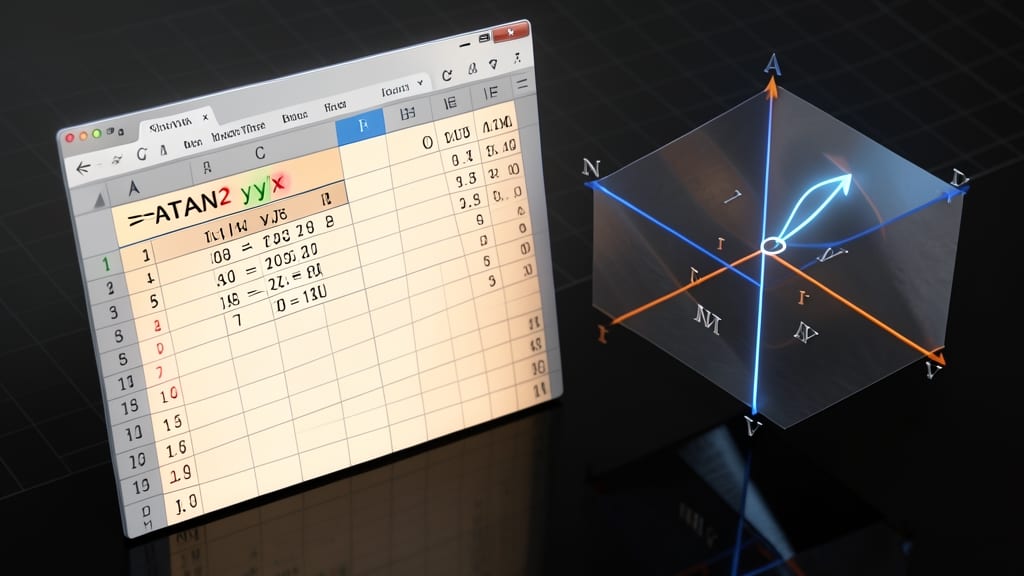
Stuck calculating angles where direction matters? The ATAN2 function solves a critical blind spot in Excel’s trig toolkit by returning the correct quadrant for any (x,y) coordinate pair—unlike ATAN, which fails when signs change.
With syntax =ATAN2(y,x), this function handles all four quadrants automatically, returning angles in radians between -π and π. For example, ATAN2(1,1) returns π/4 (45°), while ATAN2(-1,-1) correctly gives -3π/4 (-135°) instead of 3π/4. Perfect for robotics pathfinding, GPS navigation, or polar coordinate conversions.
Engineers and data scientists will love this for vector analysis or converting Cartesian to polar coordinates. Try it with =DEGREES(ATAN2(B2,A2)) to get readable degrees for any (x,y) pair. ✨
AVERAGEIFS for Weighted Data Analysis
Need to calculate an average—but only for specific conditions? AVERAGEIFS lets you filter data dynamically, making it perfect for scenarios like grading systems or performance reviews where raw averages won’t cut it.
This function takes a range, criteriarange1, criteria1, and optional additional criteria pairs. For example, you could average test scores only for students who missed fewer than 3 classes while excluding incomplete assignments. The syntax is =AVERAGEIFS(range, criteriarange1, criteria1, [criteria_range2, criteria2]...)—think of it as a smarter, more flexible AVERAGE with built-in filters.
Educators, HR analysts, and data scientists will find this especially useful for weighted calculations where context matters. Try it on your next dataset to see how much cleaner your insights become! 💡
DEGREES and RADIANS Conversion Tools
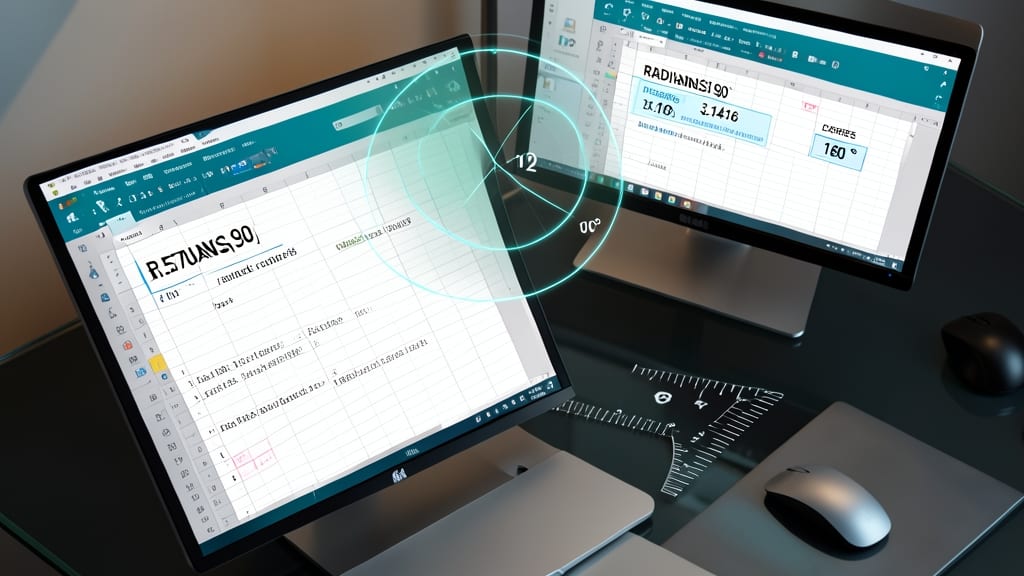
Stuck juggling angles between degrees and radians in your Excel projects? The DEGREES() and RADIANS() functions solve this instantly—no manual calculations or unit confusion required.
Simply input RADIANS(90) to convert 90° to 1.5708 radians (π/2), or DEGREES(3.1416) to reverse it back to 180°. These functions handle all conversions automatically, ensuring your trig calculations stay consistent whether your data uses degrees or radians.
Perfect for scientists, engineers, or anyone working with polar coordinates, navigation data, or physics simulations where unit precision matters. ⚡
SUMPRODUCT for Multi-Criteria Multiplication
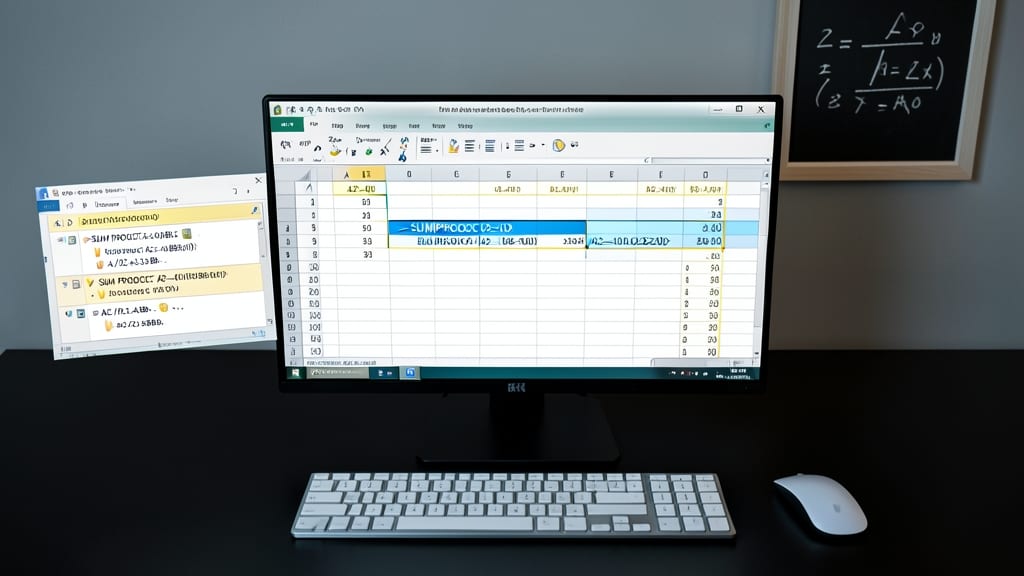
Tired of juggling multiple formulas to multiply ranges and sum the results? SUMPRODUCT combines them into a single, elegant solution—perfect for scenarios where traditional functions fall short.
This powerhouse function multiplies corresponding elements in up to 30 ranges (Excel’s limit) and returns the sum of those products. Need to calculate weighted averages? Use SUMPRODUCT(A2:A10*B2:B10) to multiply scores by weights before summing. For matrix calculations, it’s the go-to tool—think dynamic pricing models or inventory valuation where multiple factors interact.
Ideal for analysts, engineers, and finance teams, SUMPRODUCT shines when you need precision without complex VBA. Try it with your next dataset—it’s the secret weapon for advanced calculations. ✨